
Edit AI Peer Feedback into Specific Comments a Writer Can Use
Check AI-generated peer feedback against the assignment and draft, replace vague judgments with passage-specific observations, and preserve choices for the writer.
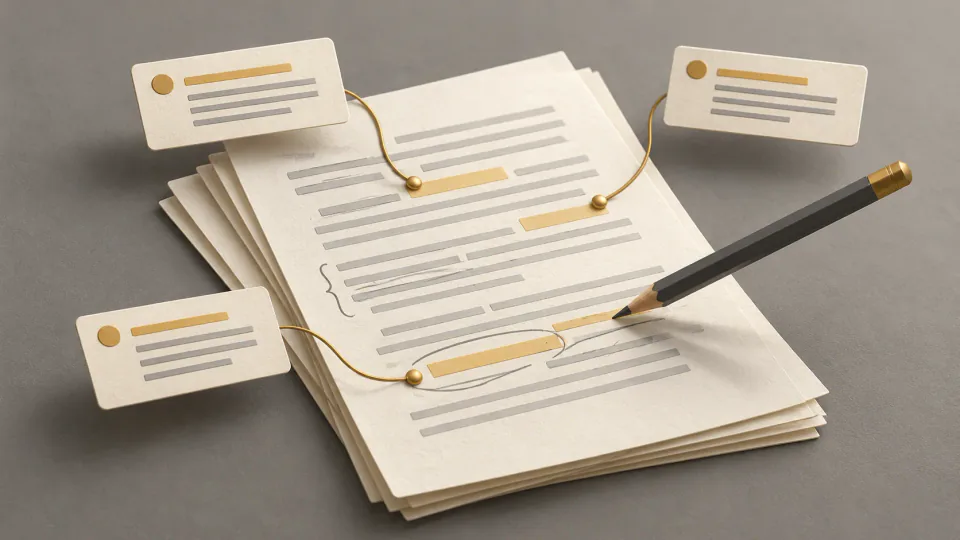
Useful peer feedback shows a writer where a reader encounters a problem and offers a possible way forward. Check AI-generated comments against the actual draft and assignment before sending them. Keep the few changes that would help most, and take responsibility for every observation you retain.
The task is responding to someone else's writing, rather than automatically rewriting it. Texas A&M's peer-response guide emphasizes the responder's perspective and the author's ownership. Cornell's feedback example uses specific, descriptive, actionable comments. Those principles help replace generic AI praise or criticism with feedback you can defend.
Read independently before consulting generated comments
Gather the prompt, rubric, audience, and writer's request. Read the whole draft at least once without AI feedback alongside it. Identify its apparent purpose, strengths, and the places where you lose the thread.
The assignment determines useful advice. Comma corrections do little for a request about argument and organization. A formal-thesis demand may be misplaced in a reflective narrative. Establish the job before evaluating suggestions.
Also establish permission to upload another person's work. It may contain unpublished ideas, personal details, or confidential sources. If permission or policy is unclear, review without uploading. The sensitive-information guide helps with privacy, but removing identifiers does not itself grant permission to share a draft.
Give an approved tool a limited task
Ask for observations related to the rubric, rather than a rewrite or authoritative grade. For example:
Identify passages where readers may struggle to connect evidence to the argument. Give short quotations and explain the possible misunderstanding. Do not invent sources or write replacement paragraphs.
Verify every quotation, paragraph number, and page reference. A tool can cite absent text, misread a deliberate choice, or assume requirements the task never imposed. Academic-writing support can assist an approved review, while the reviewer supplies the judgment.
Sort suggestions before polishing them
Use three categories: supported and important, supported but lower priority, and unsupported or irrelevant. Locate the passage behind every retained suggestion. Ask whether it describes a real reader difficulty and whether the change would serve the writer's aim.
Remove comments requesting clarity, detail, or flow without saying where or why. Combine duplicates. Two well-supported points can help more than a long list of repeated generalities.
Stanford's response guidance prioritizes larger concerns such as ideas and organization. Central New Mexico's peer-review chapter similarly separates global from sentence-level work. Follow that order unless the draft stage or request calls for another focus.
Turn a judgment into a located observation
This is an invented teaching example, not feedback on an actual student's paper.
Imagine that paragraph two makes a claim about campus transit, then supplies one rider's anecdote without explaining the connection. A tool writes:
Weak argument. Add more evidence.
That verdict leaves the writer to diagnose the problem. A reviewer could instead say:
In paragraph two, I follow the rider's experience, but I cannot yet see how it supports the claim about the entire route. Could you explain what the example establishes, or narrow the claim to fit what this account shows?
This identifies a location, describes the reading difficulty, and offers choices. It neither takes over the paragraph nor invents a citation. If you cannot locate an alleged passage, omit the point or explain the uncertainty. Describe the text's effect rather than guessing at the writer's motives or ability.
Preserve the writer's decision
Where several revisions could work, frame a next step as a question or possibility. Cleveland State's peer-review chapter describes offering perspectives rather than directives. Reporting that you expected an example to reconnect to the claim provides more information than simply ordering deletion.
Specific positive comments guide revision too. Explain what worked so the writer knows what to preserve. “The opening defines the problem before the example, which helped me follow the purpose” conveys something “Great job!” does not. Ground praise in a passage you actually read.
Shape the response around priorities
Begin with the draft's apparent aim and one or two strengths. Choose two or three changes that would most improve understanding. For each, supply a location or short phrase, explain the issue, and suggest a possible move. End with a real question for revision.
Michigan's commenting guidance distinguishes an overall response from selected margin comments. That can keep feedback focused. If AI and your reading disagree, revisit the assignment and passage. The tool is not a second independent reviewer whose agreement adds evidence.
Cornell's generative-AI teaching report discusses guided feedback alongside critical review. You remain accountable for what you send.
Read the comments from the recipient's perspective
Can the writer locate every point? Are proposed changes feasible within the assignment and word limit? Does the tone address the writing rather than the person? Remove unsupported claims and repetition. Disclose AI assistance when your setting requires it.
Do the reading yourself and send only observations you can explain. Changing the draft's wording requires the writer's permission; comparing proposed rewrites is covered in the AI-edit review guide. For the broader student workflow, see responsible AI editing.
Common questions
Should I forward all generated comments?
No. Keep comments verified against the draft and task that help the writer make a meaningful decision. Combine repetition and remove invented references or generic verdicts.
Are sentence-level comments always secondary?
No. On an unsettled argument, larger concerns usually come first. On a near-final draft, or when requested, a specific sentence issue may be most useful.
Can AI grade my peer's paper?
Follow the assignment. Peer response usually supports revision rather than claiming an authoritative grade. If a tool suggests a score, check that scoring was requested and its reasoning is supported. Do not present an unverified number as your judgment.