Fact-Check AI-Generated Text Before You Send or Publish It
Use a claim-by-claim fact-checking workflow to verify sources, quotations, dates, numerical claims, and citations before relying on an AI-assisted draft.

Before you send, submit, or publish an AI-assisted draft, read it for claims rather than style. A fluent paragraph can contain an incorrect name, invented citation, misquoted source, or statistic that says more than its evidence allows.
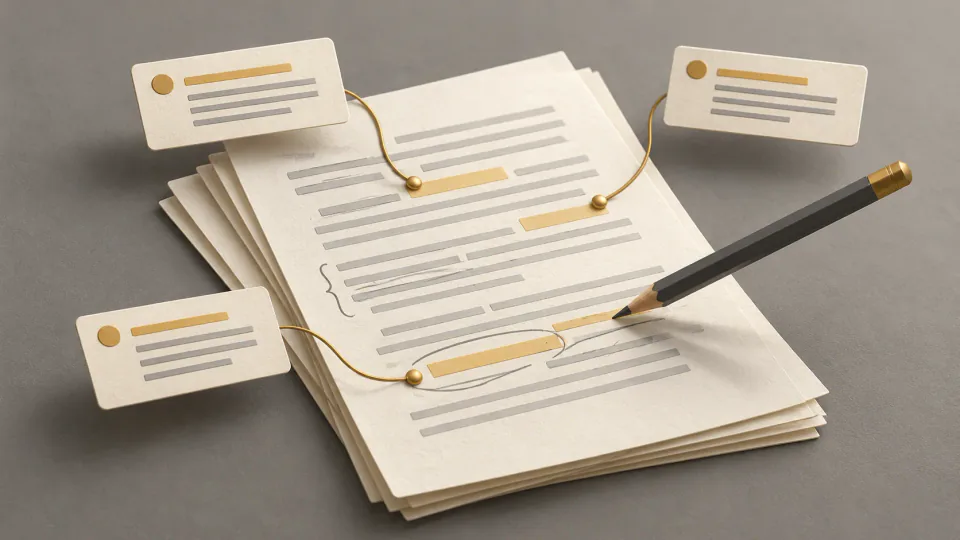
Fact-checking works best as a separate editing pass. Inventory the claims, establish their sources, correct the wording, and keep a record of what you checked. The process applies to essays, reports, blog posts, emails, and other writing where readers rely on accuracy.
Keep writing quality separate from factual support
Language models produce likely sequences of words without guaranteeing that each statement is grounded in reliable evidence. The NIST Generative AI Profile describes confabulation: confidently expressed content may be false or erroneous and can mislead readers.
A sentence can be clear and natural while remaining wrong. Rewriting it for tone does not establish its truth. For school work, combine this factual pass with the responsible AI editing workflow, which also addresses policy, citations, and disclosure.
1. Inventory the claims before changing the prose
Highlight anything a reader could reasonably ask you to prove. Common examples include:
- Names, dates, titles, locations, and organizational roles.
- Statistics, percentages, rankings, and comparisons.
- Technical or legal definitions.
- Attributed quotations and paraphrases.
- Research findings and descriptions of studies.
- Product capabilities, availability, prices, and policies.
- Report titles, references, and links.
- Strong words such as “first,” “largest,” “always,” and “proven.”
Create one checklist entry per assertion. A sentence claiming that a recent global study proved a benefit contains several claims, even though it occupies only one line. Verifying one detail should not lend borrowed credibility to the others. For a personal claim about experience, the resume-bullet review adds the question of whether you performed the work.
Distinguish facts from judgments. A statement that a policy began in June requires documentary confirmation. Calling that policy unfair requires reasoning and context. Both deserve scrutiny, but a simple lookup cannot settle both in the same way.
2. Start with consequential errors
Check all material claims, beginning with those whose failure would matter most:
- Health, legal, financial, or safety guidance.
- Statements about identifiable people or organizations.
- Quotations, references, and numerical data.
- Current rules, prices, office holders, and other changing information.
- Claims carrying the conclusion or recommendation.
A peripheral background date may need a straightforward confirmation. A statistic supporting your central recommendation deserves closer examination and, where appropriate, independent corroboration. Allocate review effort according to the consequence and uncertainty of the claim.
3. Find evidence outside the generated answer
Asking the same tool whether it was correct is not independent verification. Locate the strongest available source for each claim:
| Claim type | Preferred starting point |
|---|---|
| Policy or institutional rule | Official government or institution page |
| Study finding | Original research paper |
| Product capability | Current company documentation |
| Quotation | Transcript, recording, or first-party publication |
| Statistic | Original dataset and its methodology |
Reliable secondary material can explain a difficult source, but use the original evidence when it is available. The House of Commons Library guide to working with AI includes fact-checking guidance relevant to authoritative evidence, currency, and independent confirmation.
Match the claim's strength to the source
A related link does not necessarily support the sentence attached to it. If a paper reports an association in one small sample, it cannot substantiate “proved to work for all students.”
Compare population, period, conditions, unit, and denominator. Check whether the draft has turned correlation into causation or removed an exception. Does the evidence cover the whole sentence, or only one clause? Narrow or remove the claim until its wording reflects what the source establishes.
4. Open every reference and check quotations directly
A plausible journal name or title can conceal a nonexistent work. For each reference, confirm that:
- It exists at a publisher, library, journal, or institutional location.
- Author, title, publication, date, and identifier match.
- It contains the idea attributed to it.
- Quoted wording matches the original accurately.
- The reference points readers to the source you actually used.
If a cited work cannot be located, remove it. Do not supply guessed bibliographic details. Find a real source, read it, and reconstruct the surrounding claim from that evidence.
A plagiarism checker can supplement a review for matching wording. It does not establish that a reference exists or that the source supports your interpretation; those checks require direct reading.
5. Review dates, numbers, and surrounding context
Check the event or data date as well as the publication date. A page can rank highly long after a policy or product changes. Confirm which version applies to the claim you are making.
Recalculate simple percentages when inputs are available. Distinguish counts, estimates, relative changes, and percentage-point changes. Keep units and time frames visible. The numerical comparison guide works through denominator, baseline, and rounding mistakes.
Read beyond the search snippet. Nearby paragraphs, footnotes, eligibility criteria, or methods may contain the qualification that changes the meaning of the extracted sentence.
6. Revise with an evidence log
Use a small table while editing:
| Claim checked | Source | Status | Required revision |
|---|---|---|---|
| Exact sentence or concise assertion | Direct link or reference | Verified, revised, or removed | Correction and reason |
A shared log shows collaborators which version was checked and supports later updates. After factual corrections, make the style pass separately. Heavy rewriting calls for another meaning check; the meaning-preserving editing guide explains how to protect qualifiers while improving flow.
A fictional claim audit
Consider this invented teaching example:
A recent global study proved that most students learn faster with AI writing tools.
Its assertions include the existence of a study, its recency, global coverage, a learning-speed measure, benefit to a majority, and causation.
Suppose review instead finds a survey of perceived usefulness at two universities. Such evidence does not establish the original claim. Identify the real study, population, and measured outcome in a revised sentence, or remove the sentence when no suitable evidence exists. Do not simply add cautious words around a claim the source never tested.
Review the final copy against the log
Before using the draft, confirm that every material factual claim was listed; consequential and changing claims received attention; original sources were opened; and names, dates, numbers, units, quotations, and references were checked. Seek independent confirmation where important, remove unsupported claims, and retain a source record.
Repeat the factual check after substantial rewriting. Once the evidence is established, style editing can make it easier to understand without changing what readers are entitled to conclude.