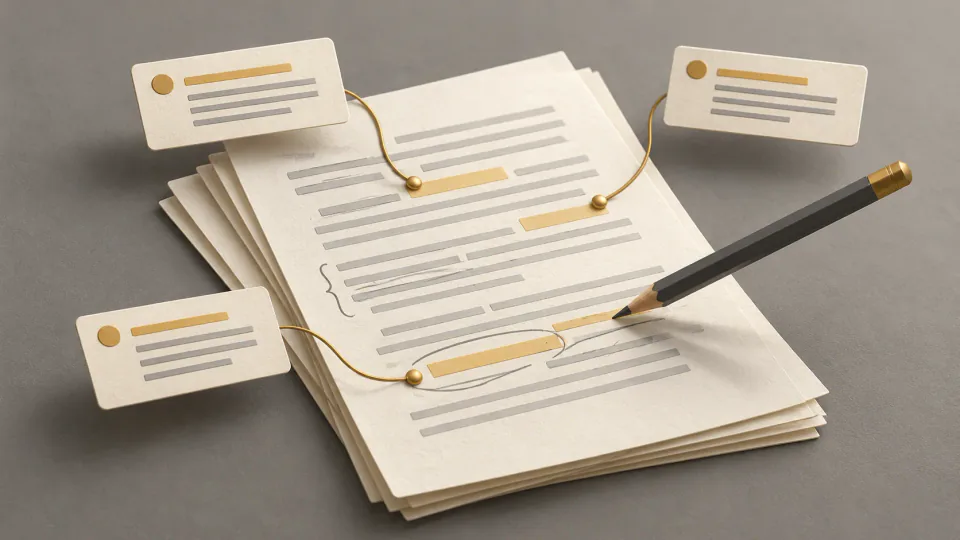
Read Turnitin and GPTZero Reports with Your Writing Process in View
Interpret a detector report alongside the assignment policy, flagged passages, verified sources, and draft history. A score alone cannot settle authorship or misconduct.

Treat a Turnitin or GPTZero report as an invitation to examine the work. Read it with the assignment rules, source evidence and writing history. A score cannot independently establish authorship or decide whether academic misconduct occurred.
Review the policy, then the report
Check which uses the assignment permits: brainstorming, language editing and drafting may have different rules. Next, read the report's own explanation of its indicators and uncertainty. Low or borderline indications deserve particular caution; high indications still require context.
The current Turnitin report guide explains that its percentage concerns qualifying text, not the probability a student cheated. Current reports do not display numerical scores or highlights for results above zero and below 20%; they use an asterisk because that range is less reliable. Its AI indicator is separate from a similarity score.
Read the flagged passages. Generic language, unsupported claims, repetition or a change of voice may identify an editing issue, but none proves AI authorship. Keep outlines, notes, drafts, source logs and revision history to explain how the work developed. The AI detection guide provides further context.
Understand the setting
| Aspect | Turnitin | GPTZero |
|---|---|---|
| Common setting | Institutional and course-system review | Standalone scans and educator workflows |
| Constructive use | Review under the institution's policy | Discussion supported by writing reports |
| Risk for students | An official-looking score can obscure missing context | An isolated scan can cause anxiety |
| Useful response | Ask how the report is interpreted | Retain drafts and explain the process |
Before submitting, confirm permitted assistance, save the outline and versions, verify citations, and replace empty generalities with supported course-specific analysis. Be prepared to explain the reasoning. The responsible editing workflow brings those checks together. An optional detector check cannot replace them.
Common questions
Are GPTZero and Turnitin equivalent?
No. Their systems, audiences, indicators and thresholds differ. Agreement or disagreement between scans does not automatically validate either result.
Can they flag humanized AI writing?
They may flag some edited text and miss other generated text. Preserve process evidence rather than treating rewriting as a guaranteed outcome.
Further source context
GPTZero's educator resources and its Million Teacher Question article describe vendor perspectives. Stanford HAI's report on non-native English writing discusses research on bias in tested detectors; it is not a current accuracy measurement for every tool.