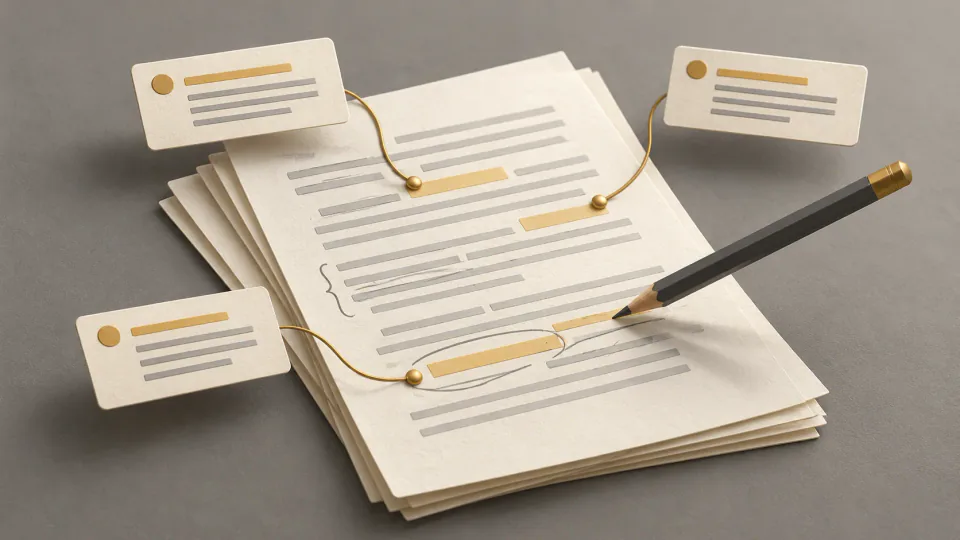
AI Detection for Students: Read Scores Alongside Your Writing Process
Understand what AI detection scores can suggest, what they cannot prove, and which drafts, notes, sources, and revision records help explain your writing process.

An AI detector looks for patterns associated with generated writing. Its result can prompt review, but it cannot establish who wrote an assignment or whether the writer followed its rules. Read the report alongside the task, human judgment, and evidence of the writing process.
Understand the score before reacting
A displayed number may describe classified text rather than the probability that a student used AI. Check the tool's own definitions. Turnitin's AI Writing Report guide explains its qualifying-text percentage, distinguishes it from similarity, and warns against using the model alone for adverse action. Its current guidance suppresses scores above 0% and below 20% because of reliability concerns.
Human and generated prose can be misclassified. Polished, formulaic, translation-supported, or heavily edited language can complicate interpretation. Stanford's account of a 2023 detector study reports false-positive concerns for non-native English writing; that study does not establish an error rate for every current detector.
Keep evidence of how you wrote
Retain the assignment and rubric, outlines and thesis drafts, reading annotations and source notes, saved versions or version history, and a short process explanation. Where relevant, keep records or screenshots of permitted tool use. Preserve authentic records as you work rather than reconstructing a history afterward.
| Result or situation | Careful interpretation | Useful action |
|---|---|---|
| Low or uncertain indication | May be a borderline signal or error | Keep process evidence and read the report definition. |
| High indication on generic prose | Style may deserve review; the score does not diagnose authorship | Check sources, examples, and your reasoning. |
| ESL writing flagged | Predictable language may affect classification | Explain drafting, translation limits, and revision history. |
| Tools disagree | Models and thresholds differ | Avoid treating one result as decisive. |
Respond with evidence, then improve the writing
If work is flagged, gather drafts, notes, sources, outlines, and version history. Give a factual account of how you developed the assignment and used any allowed assistance. Follow the institution's review process. Cornell's academic-integrity guidance provides context for policy-aware use and verification.
Do not edit solely to lower a score. Make the work specific, sourced, and explainable. If using the AI detector, treat its report as one limited signal. Read the Turnitin and GPTZero guide, the discussion of flags after humanizing, or ESL writing support for the relevant next step.
Common questions
Can detectors be wrong?
Yes. False positives and false negatives are possible. A report is a review signal, not a final authorship verdict.
What should I do after a flag?
Stay factual. Present the genuine drafts, notes, sources, version history, and process explanation that show how you completed the work.