Check AI-Assisted Writing by Tracing Words and Ideas to Their Sources
Audit the sources behind an AI-assisted draft, identify close paraphrases, repair attribution, and distinguish a useful source review from a similarity or detector score.
A correct fact can still be used unfairly. An AI-assisted paragraph may borrow a source's distinctive phrase, retain its sentence structure, or present its idea without explaining where it came from. Those problems require source review, even when the prose sounds natural and the claim is true.
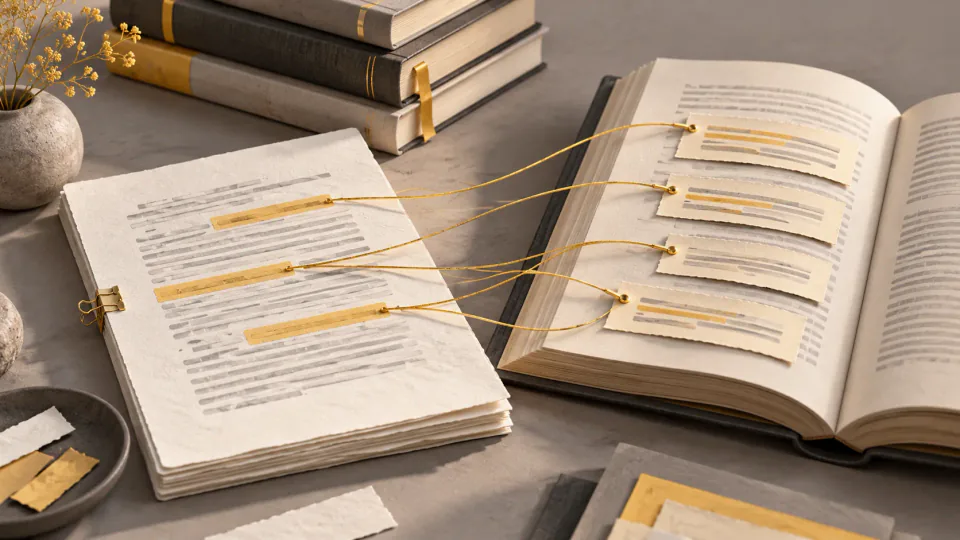
Review important passages by tracing their provenance: where did these words and ideas originate, what form should they take here, and can the reader see the attribution? That makes a plagiarism check a series of decisions you can explain.
Separate three different reviews
Plagiarism review concerns the representation and attribution of borrowed language and ideas. Citation verification establishes whether a reference exists and supports the adjacent claim. AI detection estimates patterns associated with generated text. A detector result establishes neither authorship nor plagiarism.
Begin by verifying the draft's claims and references. Then inspect source use. An existing citation may support a different claim, and a true statement may still require attribution. A plagiarism checker can help identify passages worth comparing, but its output cannot make these editorial decisions for you.
Assemble the source trail
List the material that informed the draft: webpages, readings, datasets, interviews, lecture materials and your notes. Include an AI-suggested reference only after opening and verifying it. For each source, save citation details and a stable link or file, the pages or sections consulted, your summary, and the draft passages that rely on it. Clearly distinguish copied words from your own notes.
The University of Michigan's logistical guidance on source use recommends maintaining that distinction. It matters particularly when material passes through several tools and files. An unmarked quotation in research notes can later look like your own sentence.
A tool's explanation of where a phrase came from is not proof. Trace unfamiliar claims and distinctive language yourself. If you cannot establish an origin or reliable support, remove the material or replace it with something you can verify. Do not let a plausible generated reference fill the gap.
Label passages by what they do
Read paragraph by paragraph and mark significant claims or phrases with one of six labels:
- Quotation: exact language from a source.
- Paraphrase: a particular source idea expressed with independently constructed wording and syntax.
- Summary: a shorter account of a larger section or argument.
- Common knowledge: information your disciplinary and audience context ordinarily does not require you to cite.
- Your analysis: an interpretation, comparison, inference or conclusion you contribute.
- Origin unclear: material whose path into the draft you cannot yet trace.
The last label requires action. Search notes and prompts, locate a genuine supporting source, and revise. It cannot remain a way to present uncertain material as your own. Common knowledge also depends on context; do not apply the label simply because the claim feels familiar.
Look for imitation beyond identical words
Patchwriting can retain a source's framework while replacing some vocabulary. Compare likely source passages with your draft for the same idea sequence, sentence skeletons with synonyms inserted, distinctive phrases, or several borrowed sentences compressed without clear attribution. Also check whether a paragraph-end citation leaves the beginning of the borrowing ambiguous.
University of Michigan's discussion of patchwriting explains how close imitation may arise while learning from a source. It still needs revision before submission. Changing several verbs is insufficient if the sentence remains constructed from the original.
A similarity report can locate exact matches, including quotations that are already correct. It may miss structural imitation or material outside its comparison database. Read the relevant source beside the draft before deciding what a match means. The objective is defensible source use, not a particular percentage.
Select the right way to use the source
Quote when the wording itself matters. Apply quotation marks or the required block format, introduce the quotation, give precise attribution and explain its role. Quoting should support an argument you understand.
Paraphrase when you need the particular idea. Preserve the meaning while rebuilding both language and structure. Attribution remains necessary. George Mason's paraphrasing guidance recommends understanding the passage, setting it aside, drafting, and comparing the result with the source.
Summarize when readers need a broader account. Compression does not make the source contribution yours. Identify whose argument or evidence you are condensing.
Write analysis when the interpretive move is yours. First establish what the source says, then explain your inference. Cite its evidence without implying that the source also made your conclusion. Clear transitions let readers distinguish the two contributions.
Repair a close paraphrase from understanding
Do not keep the borrowed sentence on screen and replace words one at a time. Read until you can explain the point, hide the source, and draft for your own audience and purpose. Then reopen the source to compare meaning, scope and wording. Restore any missing condition or uncertainty, add the citation, and quote exact language that needs to remain.
Harvard's plagiarism-avoidance guidance emphasizes distinguishing source material from your own ideas. Doing that during drafting is more reliable than attaching references after the language has become difficult to trace.
If you use a paraphraser for another wording option, repeat the comparison afterward. Fluency does not establish independence from the source, and a rewrite may strengthen a qualified claim. The meaning-preserving editing guide helps check scope and uncertainty.
An illustrative comparison
Imagine a source says students remember a process better by retrieving its steps from memory rather than immediately rereading. This is an invented teaching setup; ‘Source’ below is a placeholder, not a research reference.
A close version is: ‘Students remember a process more effectively when they retrieve the steps from memory rather than rereading them right away (Source).’ A citation acknowledges the idea, but the sentence still closely imitates the original structure. ‘More effectively’ does little editorial work.
An independently framed version might be: ‘To check your understanding, put the instructions away and try to reconstruct the procedure unaided (Source).’ You might then use gaps in your reconstruction to guide further review. That practical application should be checked against the actual source before use; it must not claim an outcome the evidence never established. Even a well-formed paraphrase still needs attribution.
Make the citation's reach visible
A bibliography does not tell readers which sentences came from which source. Cite at the point of use, with page, paragraph, section or timestamp details when the required style calls for them. Ensure that every quotation is formatted and cited, and every paraphrase or summary has attribution whose scope is clear.
Check that the reference entry describes the work you actually opened, that its link or identifier reaches the correct work, and that one citation is not stretched across unrelated statements. Purdue OWL's paraphrasing guidance likewise connects attribution with accurate comparison against the original.
Use a short source-use audit
| Passage or claim | Origin | Intended form | Attribution | Required action |
|---|---|---|---|---|
| Identify the wording or idea. | Known, uncertain or unknown | Quotation, paraphrase, summary, common knowledge or analysis | Complete, incomplete or missing | Keep, verify, quote, rewrite, cite or remove |
For a long paper, start with central claims, numerical facts, definitions, distinctive language and passages drafted directly from notes. Continue until no material passage has an unexplained origin. This table records reasoning; it is not a substitute for checking the sources.
If you cannot trace a passage, search notes, browsing history and saved prompts. Search a distinctive phrase in quotation marks. Locate and read credible evidence, then rewrite from that verified material. Never attach a merely related citation to make an uncertain sentence look supported. Remove it if you cannot establish adequate support.
Review the complete draft before submission
Confirm that the source inventory is complete, copied notes are marked, and unfamiliar generated material has been traced. Recheck paraphrases against originals, exact wording for quotation formatting, and borrowed ideas for citations placed close enough to show their scope. Verify every reference and remove unresolved material.
Finally, follow the assignment's rules for AI assistance and disclosure. The responsible student editing guide places that requirement alongside source verification and human review. Disclosure does not replace attribution; both may be needed. A trustworthy draft lets readers follow the path from evidence to sentence and see where your own analysis begins.