How to Review AI Writing for Bias Before Publication
Review AI-assisted drafts for unequal assumptions, unsupported group claims, missing agency, and absent perspectives with a practical passage-by-passage audit.

Bias can survive a careful grammar check. A draft may get dates and names right yet explain one person's success as skill and another's as luck. It may give a community problems without goals, assume the audience has the same resources, or present a finding about a small sample as a trait of an entire population.
Reviewing that framing takes more than replacing uncomfortable words. You need to examine the evidence behind a claim, the agency given to people, the comparisons being made, and the perspectives absent from the account. The aim is a more accurate and fair passage. No editing checklist can certify that a text contains no bias.
Decide which problem you are fixing
Three checks belong together, but they answer different questions:
| Check | Question to ask |
|---|---|
| Factual accuracy | Does a reliable, current source support this claim? |
| Framing | Does the passage apply unequal assumptions, standards, or explanations to people? |
| Inclusive style | Are identity labels necessary, precise, respectful, and appropriate to this context? |
Consider “Older employees resist new software.” A real survey might sit behind the sentence, but the survey may cover one workplace or ask about access to training. A gentler replacement for “older” cannot fix that gap. First establish the evidence with a source-based fact check; then examine what the draft asks readers to infer.
1. Find every passage that characterizes people
Mark claims about ability, motivation, behavior, culture, risk, success, failure, or need. Include identity references that appear indirectly through comparisons and examples. Review headings, captions, and titles as closely as the body.
Useful warning signs include adjectives that judge a person's character, words such as “naturally” and “normal,” and descriptions of communities entirely through what they lack. Notice who gets leadership roles in invented scenarios, who supplies expertise, and who appears only as a recipient of help. Recommendations also deserve attention: a process that assumes broadband, family support, evening availability, or a particular body may exclude some readers.
Treat generated quotations and supposedly representative experiences as source questions. Smooth wording does not establish that anyone actually said or experienced them. Patterns matter too: a single neutral sentence can contribute to an unequal picture across a whole article.
2. Separate observations from explanations
For each marked passage, write down what can be checked and what the writer has inferred. “Participants could not locate the control” describes an observation. “Participants dislike technology” assigns a motive.
Use these questions to examine the distinction:
- Is the group label needed, and is it as specific as the source allows?
- Which population, place, period, and sample support the behavior claim?
- Was a cause observed, reported by participants, or guessed by the writer?
- Were compared groups assessed using equivalent measures?
- What resources or circumstances does the recommendation assume?
A study involving 60 volunteers in one city cannot, on its own, establish how everyone from a culture behaves. Restore the sample and setting, along with relevant uncertainty. If you cannot find dependable support for a group claim, remove it or turn it into an explicit question for investigation. Plausibility is insufficient evidence.
If a group claim comes from a survey, also review the wording of its questions. A leading question can shape the answer before a summary is written.
3. Swap an identity marker and reread
An identity swap can make a hidden assumption easier to notice. Keep the described action constant and change the marker under review.
The young manager was ambitious, while the older manager was stubborn about the plan.
Now reverse the ages:
The older manager was ambitious, while the young manager was stubborn about the plan.
If one version feels unexpectedly harsh or flattering, investigate why. The exercise is a diagnostic, not proof that the original sentence is biased. Perhaps one manager proposed expansion and the other documented a safety concern. Those actions give the reader firmer information than an unsupported judgment about personality.
NIST's Generative AI Profile includes counterfactual and low-context prompts among approaches to assessing harmful bias. Applying a simple swap during editing is a practical adaptation: use it to locate wording that needs evidence and context, rather than treating it as a fairness score.
4. Make labels relevant and specific
Before choosing a label, decide whether the identity detail belongs in the passage at all. Include it when it helps explain the subject; omit it when it is incidental decoration.
When a detail is relevant, use the person's stated terminology where available and the level of specificity supported by the source. Follow the publication's applicable style guidance, while remembering that terminology and preferences change. Broad populations do not share one culture, opinion, or preferred description.
Person-first and identity-first language require contextual judgment. Neither is an all-purpose rule. Purdue OWL's guidance on avoiding bias discusses preferred identifiers and the problems with language that makes one population the default. When the right wording remains uncertain, consult a relevant current guide or the people being described.
A grammar and style review can help you inspect the revised sentences. An automated suggestion cannot decide which identity detail is relevant or speak for a community's preferences; those decisions need human review.
5. Compare the standards, not just the words
Read descriptions of related people side by side. Check whether the text gives one person the benefit of context while making another explain every decision.
Does achievement become “skill” for one group and “help” for another? Does the same assertiveness become leadership in one person and aggression in another? Are mistakes treated as individual incidents for one population but evidence of a group trait for another? Look also at whether comparable risks, costs, and benefits receive comparable attention.
Agency is part of this check. One group may make decisions throughout the story while another is merely affected. Evidence can be unequal too: experts may represent one side while anecdotes stand in for the other. Repair the passage by describing observable actions, using equivalent support, and giving comparable detail wherever the underlying facts allow it.
6. Ask whose perspective shapes the account
Adding a sentence that calls a community “diverse” does little if every meaningful choice still belongs to someone else. Review who explains the problem, whose goals are visible, and who is allowed expertise.
The University of Illinois Chicago's inclusive language guide encourages asset-based framing and attention to missing voices. In an editorial review, that means asking whether people appear only through need, whether “we” actually includes the reader, and whether a first-person source could change the account.
Do not fill an evidence gap with an invented quotation or experience. Seek a real source or appropriate review, narrow the statement, or acknowledge the limitation. Fairer framing still has to be sourced.
7. Repair the claim at its root
The following examples are fictional illustrations, not reported research. Use their structure only when your own sources support the details.
Move from a supposed trait to documented conditions.
Rural customers are reluctant to adopt digital services.
A supported version could instead say:
In the 2025 survey of customers in three rural counties, respondents most often identified unstable broadband and limited in-person support as barriers to using the service.
This identifies a population, an evidence source, and conditions that might be addressed. It does not assume a shared attitude.
Describe existing capacity alongside a specific barrier.
The neighborhood lacks the skills needed for the program.
A more informative account might read:
Residents already coordinate a volunteer network. The program also requires software training and evening access, neither of which the implementation plan currently provides.
The barrier remains visible, but so do residents' contributions and the plan's responsibility for the mismatch.
Keep the conclusion within the sample.
International students prefer formal English.
With appropriate interview evidence, the claim could become:
In interviews for this course, 8 of 12 participating international students said they used a more formal tone in assessed essays than in class discussion.
That limited statement is more useful than a broad generalization, even a complimentary one. For related language decisions, see ESL editing that preserves the writer's voice.
Keep a record for longer reviews
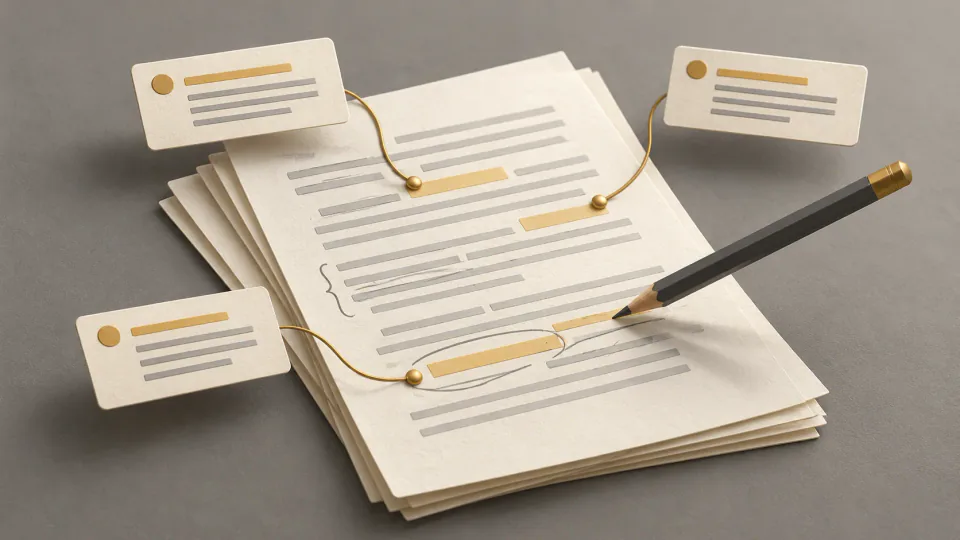
An audit table makes editorial judgments available to the next reviewer.
| Passage | People described | Evidence available | Concern | Missing context | Revision |
|---|---|---|---|---|---|
| Paragraph 3 | Age group | Regional survey | Correlation becomes a personality trait | Workplace accessibility information | Restore scope and limitations |
| Example 2 | Gender | Invented scenario | Leadership and support roles follow defaults | Review other examples | Reassign roles and inspect the pattern |
| Conclusion | Disabled participants | Program documentation | People appear only through need | Participant goals and expertise | Add a real, relevant perspective |
The table documents reasoning. It does not convert a judgment into an objective measurement.
A worked passage: a budgeting app
Here is another fictional draft:
The new budgeting app is simple enough for elderly users. Unlike younger customers, they are often confused by digital tools, so family members should manage the account for them.
Several assumptions are doing the work. The label may conflict with audience preferences. “Simple enough” implies a usability conclusion without a measure. Age becomes the explanation for confusion; a family member is assumed available; and users lose control over their own accounts.
If real usability findings supported the following details, an evidence-based revision could read:
In usability sessions with 24 adults aged 65 to 82, seven participants had difficulty finding the recurring-payment controls. The next release will add persistent labels and an optional guided setup. Users may invite a trusted contact if they choose.
The example retains the original numerical logic: seven of the 24 tested adults encountered a particular problem. It connects that observation to a product response and preserves choice. None of those figures or plans should be inserted into a real article unless verified. Without the evidence, remove or qualify the claim while the team investigates.
Know when another reviewer is needed
Use subject expertise and community-informed review when wording could affect rights, safety, access, reputation, or material decisions. Hiring, admissions, grading, health, housing, credit, benefits, legal services, and public policy are examples where the consequences warrant closer attention.
A technical expert can check domain claims. An appropriate sensitivity reviewer or someone from the affected community may identify assumptions outside a general editor's experience. Neither can guarantee a bias-free result. Keep a human owner accountable, preserve source notes, and record AI assistance where required. The responsible AI editing workflow offers a related sequence for policy, verification, authorship, and disclosure.
Before publication, confirm that group claims have evidence-sized scope, labels have a reason to be there, comparisons use parallel standards, and missing perspectives have been addressed honestly. Check the revised text once more for inferred motives, default roles, invented experiences, and lost agency. Those are passage-level decisions; a clean vocabulary list alone cannot resolve them.