
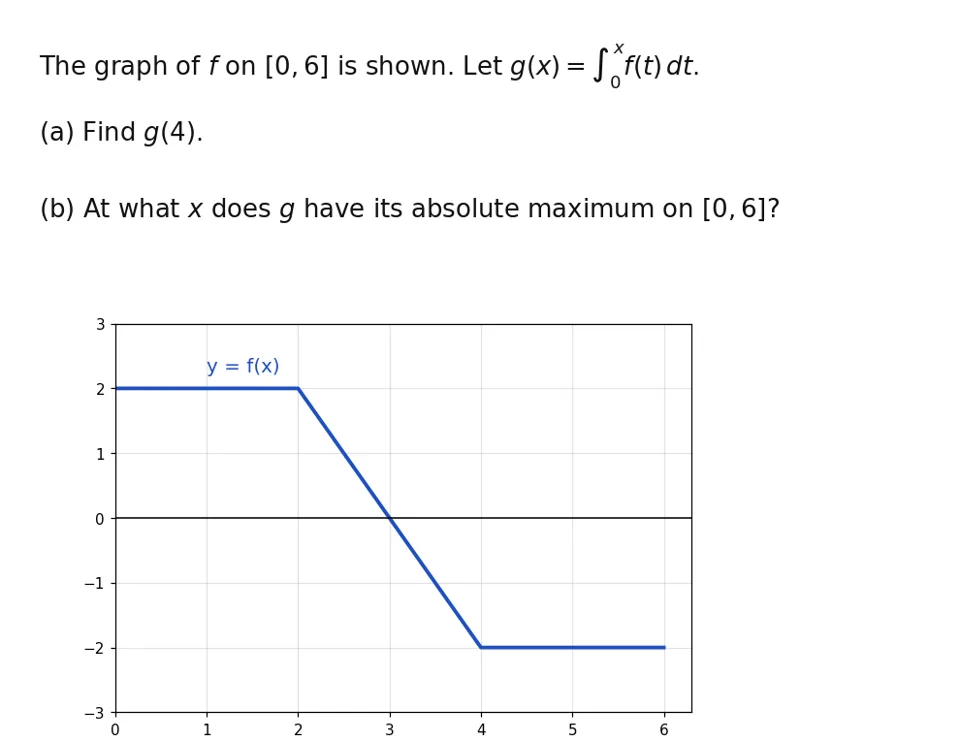
Problem: The graph of on is shown. Let . (a) Find . (b) At what does have its absolute maximum on ?
Part (a)
Steps
- , which equals the net area between the graph of and the -axis from to .
- From to , . This is a rectangle with width and height :
- From to , decreases linearly from to . This is a triangle above the -axis with base and height :
- From to , decreases linearly from to . This is a triangle below the -axis, so its contribution is negative. It has base and height :
- Add the signed areas:
Part (b)
Steps
- By the Fundamental Theorem of Calculus, . So increases when and decreases when .
- On , , so is increasing on this interval.
- At , .
- On , , so is decreasing on this interval.
- Since increases up to and decreases afterward, reaches its absolute maximum at .
Answer: (a) . (b) has its absolute maximum at .